

Why losing a relationship can feel like losing a part of yourself—and how to begin finding your way forward.
Breakups can be some of the most emotionally painful experiences we encounter. Whether a relationship lasted six months or twenty years, whether you initiated the separation or it came unexpectedly, the ending of a meaningful relationship can leave you feeling lost, overwhelmed, and uncertain about your future.
Perhaps you find yourself replaying conversations, wondering what you could have done differently, or fighting the urge to reach out to someone who was once an important part of your everyday life.
You might even feel embarrassed by how much you're struggling.
But here's something important to understand: the pain of a breakup is real, and what you're experiencing may be grief.
At Tender Roots Therapy & Wellness in Halifax, Nova Scotia, we recognize that relationship loss deserves the same compassion and care as other significant life transitions.
Why Do Breakups Hurt So Much?
When we form close relationships, we develop emotional bonds that help us experience connection, comfort, belonging, and security - These are basic attachment needs, we cannot downplay what it means.
From an attachment perspective, romantic partners can become important sources of emotional regulation. We turn toward them during difficult moments, share our vulnerabilities, and gradually build routines and expectations around their presence. When that relationship ends, we're not simply losing a person.
We may also be losing:
An Identity as someone who is lovable and worthy.
A sense of emotional safety and familiarity.
Daily routines, rituals, and companionship.
Shared friendships, family connections, or community.
Dreams about marriage, children, travel, or growing old together.
A version of ourselves that existed within the relationship.
The future we imagined we were building.
This is why heartbreak can feel so disorienting. The person you once turned to for comfort may now be the person you're grieving. And that creates a particularly painful emotional contradiction.
Breakups Are a Form of Grief
We often associate grief with death, but grief can emerge whenever we experience a meaningful loss. It can be even harder to grieve someone who is still here, because in grief we can be haunted by regrets and feel the needs for closure, there is always this looming sense they are just within reach, even if we know distance is the right thing. Distance can feel like torture at times.
The Canadian Centre for Addiction and Mental Health (CAMH) recognizes relationship breakups as one of the many experiences that can lead to grief.
Following a breakup, you might experience sadness, anger, anxiety, guilt, loneliness, relief, or even moments of hope. Sometimes these feelings appear simultaneously. You may miss someone deeply while also recognizing that the relationship wasn't healthy for you. You might feel confident about your decision one morning and completely devastated that evening.
Healing from a breakup isn't linear. There isn't a universal timeline for recovering from heartbreak, and grief doesn't follow a predictable sequence. At anyone time we could be in one of the stages of grief
The Grief of Losing an Imagined Future
One of the less-discussed aspects of heartbreak is grieving the future that never happened. Perhaps you imagined buying a home together, raising children, or celebrating important milestones. Even if the relationship was difficult, those dreams may have represented something meaningful: security, belonging, family, or hope. When the relationship ends, those imagined possibilities can disappear alongside the relationship itself. Giving yourself permission to grieve those losses is an important part of healing.
Therefore, it is important to note the 7 stages of Grief outlined below - we may be at one stage at any given time or in three stages in one day, or in one stage for a month. It is important to recognize what stage we are in and what is keeping us stuck there.
The 7 Stages of Grief
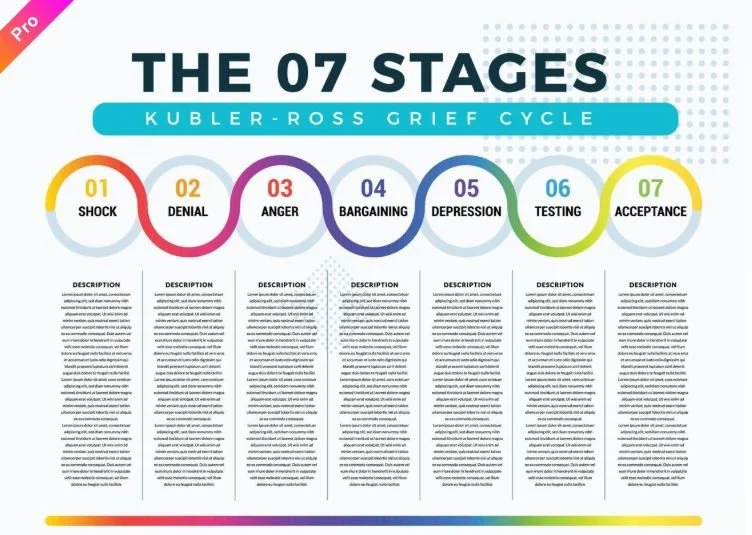
The 7 Stages of Grief - Grief Is Not Linear: Learning to Trust the Process
While the seven stages of grief can help us make sense of our emotional experiences, it's important to remember that grief is not a linear process. We may move between stages, experience several at once, revisit feelings we thought we had worked through, or find ourselves spending longer in one stage than another. There is no correct order, timeline, or way to grieve.
Sometimes, we may feel as though we're stuck in a particular stage. Perhaps we're holding onto anger because it feels safer than sadness, bargaining because we're not ready to let go of hope, or experiencing depression as we begin to confront the reality of our loss. Rather than viewing these experiences as obstacles to overcome, we can approach them with curiosity and compassion. What is this emotion trying to tell us? What might we be afraid to feel, acknowledge, or release?
Grief has a way of changing as we make space for it. When we allow ourselves to acknowledge our sadness rather than continually fighting against it, we may gradually discover moments of clarity, curiosity, and openness to new possibilities. In the seven-stage model, this movement is sometimes described as transitioning from depression toward testing—where we begin exploring new ways of living—and eventually toward acceptance. However, these transitions are not automatic or inevitable, and acceptance does not mean that sadness disappears.
Healing isn't about forcing ourselves into the next stage. It's about creating enough space for our emotions to be felt, understood, and integrated. Sometimes we move forward, sometimes we revisit familiar feelings, and sometimes we need additional support to navigate what feels overwhelming. We can trust that our relationship with grief has the capacity to change, even when we cannot yet imagine what life will look like on the other side.
And perhaps most importantly, acceptance doesn't mean we stop grieving. It means we gradually learn how to carry our loss while continuing to live.
Why Can't I Stop Thinking About My Ex?
After a breakup, many people experience repetitive thoughts about their former partner.
You might find yourself:
Replaying arguments or important conversations.
Searching for signs that the relationship could have been saved.
Checking social media for updates.
Wondering whether your ex misses you.
Comparing yourself to a new partner.
Imagining reconciliation.
These thoughts can be especially intense when the relationship ended unexpectedly or without a satisfying explanation. Our minds naturally seek understanding and resolution following emotionally significant experiences. However, repeatedly searching for answers can sometimes keep us caught in cycles of rumination.
Rather than asking yourself, "How do I stop thinking about this person?" consider asking:
"What is this relationship loss bringing up for me, and what might I need right now?"
Perhaps you need reassurance, emotional safety, connection, or an opportunity to express feelings that have gone unheard. Understanding the need beneath the thought can be more helpful than trying to force the thought away.
Attachment Styles & Breakup Recovery
Attachment theory offers another way to understand why breakups affect people differently. Our attachment patterns can influence how we respond to separation, uncertainty, and emotional loss.
Someone with anxious attachment tendencies may experience an intense desire for reassurance, struggle with uncertainty, or feel compelled to reconnect. Someone with avoidant attachment tendencies may distance themselves emotionally, focus on independence, or experience grief more privately. People with more secure attachment patterns can also experience profound heartbreak.
These patterns are not fixed identities, and they don't determine whether someone is capable of healthy relationships. They simply offer a framework for understanding how we seek safety and connection.Therapy can help individuals recognize these patterns and develop healthier ways of responding to relationship distress.
Learn more about Limerence & Attachment Styles
6 Ways to Cope With a Breakup
1. Allow Yourself to Grieve
You don't need to minimize your pain because the relationship ended rather than someone passing away. There is no shame in loving and allowing yourself to feel the loss. It meant something and that matters.
Sadness, anger, confusion, and longing can all be understandable responses to loss, they can feel unbearable, and in the stages of grief at first we may find ourselves bouncing between “anger” “Bargaining” and “Despair” - we may stay here for a long time. We would not be human if we just moved on quickly.
We need to go through our emotions to process them and understand if they are connected to attachment wounds. It makes sense to be sad when things are sad, you are already suffering enough so try making space for your emotions without immediately judging or attempting to eliminate them.
2. Create Boundaries That Support Healing
For some people, temporarily limiting contact with an ex-partner can provide emotional space. This might include muting social media, avoiding repeated conversations about reconciliation, or establishing clearer communication boundaries. However, no-contact approaches aren't appropriate or necessary for everyone, particularly when children, shared responsibilities, or practical obligations are involved. The goal isn't punishment. It's creating enough emotional safety to begin healing.
3. Reconnect With Your Identity & Values
Relationships naturally influence how we understand ourselves. After a breakup, you may need time to rediscover your preferences, values, interests, and goals outside the relationship.
Consider asking yourself:
What parts of myself have I neglected? What brings me joy independently? What kind of life do I want to build moving forward? What do I value in a relationship that I was not getting?
4. Outsourcing our needs
Relationships often fill certain attachment needs - (1) companionship & friendship - to feel seen, heard, validated; (2) to have emotional intimacy, ie. being able to be vulnerable, open, honest, and have someone accept our flaws; (3) to have physical intimacy, which may increase our sense of confidence, self-worth, and feeling desired and enough; and (4) giving us a sense of purpose and meaning.
These are universal needs, and we cannot negotiate we have these. However, we can negotiate how we meet these needs. Therefore, it is important to outsource these universal needs from other sources - for example, is there a friend I can be vulnerable with? Can I go to therapy? Is there a new class I can take or people or pets I can spend time with or volunteering that connects me to a sense of purpose?
5. Support Your Nervous System
Loss can be a HUGE hit to the nervous system - where every emotion and physical sensation can show up at once and retrigger old rejection or abandonment wounds. So it is important to support your body through the grieving process. Emotional distress can take more of a toll than physical exercise such as a big workout, and can affect sleep, appetite, concentration, and physical well-being - so it is important ensure your eating enough, sleeping enough and hydrating.
Supporting our Nervous System can look like reminding ourselves we are safe, exploring gentle movement, consistent meals, adequate rest, mindfulness, journaling and spending time with supportive people can help you navigate this period. You don't need to create an elaborate self-care routine. Sometimes healing begins with the smallest acts of care - like drinking a few glasses of water, trying to shower or going for a walk.
6. Challenge the Story That You Weren't Enough
Following rejection or separation, it's common to internalize the ending of a relationship as evidence of personal inadequacy. You might think:
"If I were more attractive, more successful, less emotional, or easier to love, they would have stayed."
But relationships are complex. Their endings cannot always be explained by one person's shortcomings. Your relationship status does not determine your worth.
7. Seek Support Rather Than Isolating
Talking with trusted friends, family members, or a therapist can help you process difficult emotions. You don't need to wait until you're completely overwhelmed to seek support. You deserve care while you're grieving, not only after you've reached a breaking point.
8. Give it time
I know you are going to hate this one - but relationship Grief takes time. This is because it meant something. We would not be human if we just moved on after loving. Loving is risking loss, that’s part of why its so vulnerable and beautiful. Grief itself is not about forgetting, it is about learning to live with and tolerate distress and missing someone, while also realizing you deserve happiness and someone who chooses you and treats you right. Healing just does take time, but if we face it head on it will heal faster. We have to go through the pain to get to the other side, the more we supporess it the more it will come out to hurt us later on in how we treat others or ourselves.
When Should You Consider Therapy After a Breakup?
Breakup counselling may be particularly helpful if you're experiencing persistent anxiety, difficulty functioning, overwhelming self-blame, intense fear of abandonment, or recurring patterns in romantic relationships.
Therapy can provide space to explore your attachment needs, rebuild self-esteem, process grief, and develop a stronger understanding of yourself.
At Tender Roots Therapy & Wellness, our therapists offer compassionate support for relationship challenges, grief, self-worth, and major life transitions.
You don't have to navigate heartbreak alone.
Moving Forward Doesn't Mean Forgetting
Healing doesn't require you to stop caring about someone or pretend the relationship wasn't meaningful.
Sometimes moving forward means learning to hold the memories differently.
It means acknowledging what mattered, accepting what cannot be changed, and gradually making room for new experiences.
You can miss someone and still choose yourself.
You can grieve what was lost while remaining open to what comes next.
And perhaps most importantly, you can begin again without having to become an entirely different person.
At Tender Roots, we believe healing begins with compassion, curiosity, and connection.
If you're struggling with heartbreak or relationship grief, we invite you to connect with our team in Halifax, Nova Scotia.
Learn more about Tender Roots Therapy & Wellness
References & Canadian Resources
Centre for Addiction and Mental Health (CAMH). Coping with Loss and Grief.
Centre for Addiction and Mental Health (CAMH). Loss, Grief and Healing.
Canadian Mental Health Association. Mental Health Resources.
9-8-8 Suicide Crisis Helpline. Confidential Crisis Support in Canada.
This article is intended for educational purposes and does not replace individualized mental health care.
